
Introduction: The Journey from Mountain to Masterpiece
Every slab of natural stone that adorns luxury hotels, modern kitchens, and grand architectural projects begins its journey deep within the earth. For centuries, Turkey has been one of the world's most important sources of premium natural stone — from the iconic white marbles of the Aegean coast to the rich travertines of Denizli. But what exactly happens between the moment a stone block is extracted from the mountain and when it arrives at your project site? In this behind-the-scenes look, we take you inside a working Turkish marble quarry to reveal the fascinating process that transforms raw rock into refined building material.
Where Are Turkey's Marble Quarries Located?
Turkey sits on some of the world's most geologically rich terrain, with significant marble and travertine deposits spread across several regions:
- Aegean Region (Muğla, İzmir, Afyon): Home to world-famous white and grey marbles, including Milas, Afyon Sugar, and Mugla White.
- Central Anatolia (Konya, Eskişehir, Bilecik): Rich in travertine deposits, particularly the ivory and noce varieties around Denizli.
- Marmara Region (Bursa, Balıkesir): Known for Marmara White marble, quarried since Roman times.
- Mediterranean Region (Antalya, Burdur): Limestone and onyx deposits with warm, earthy tones.
Each region produces stone with distinct characteristics — from the dramatic veining of Calacatta Viola to the subtle warmth of Antalya Limestone. Understanding the geological origin of a stone helps architects and designers select the perfect material for their projects.
The Extraction Process: From Rock Face to Raw Block
Surveying and Planning
Before any stone is cut, geologists and quarry engineers conduct extensive surveys using drone mapping, core sampling, and 3D terrain modelling. This careful planning ensures that extraction maximises yield while minimising waste and environmental disruption. Modern Turkish quarries invest heavily in technology to optimise their operations.
Channel Cutting and Benching
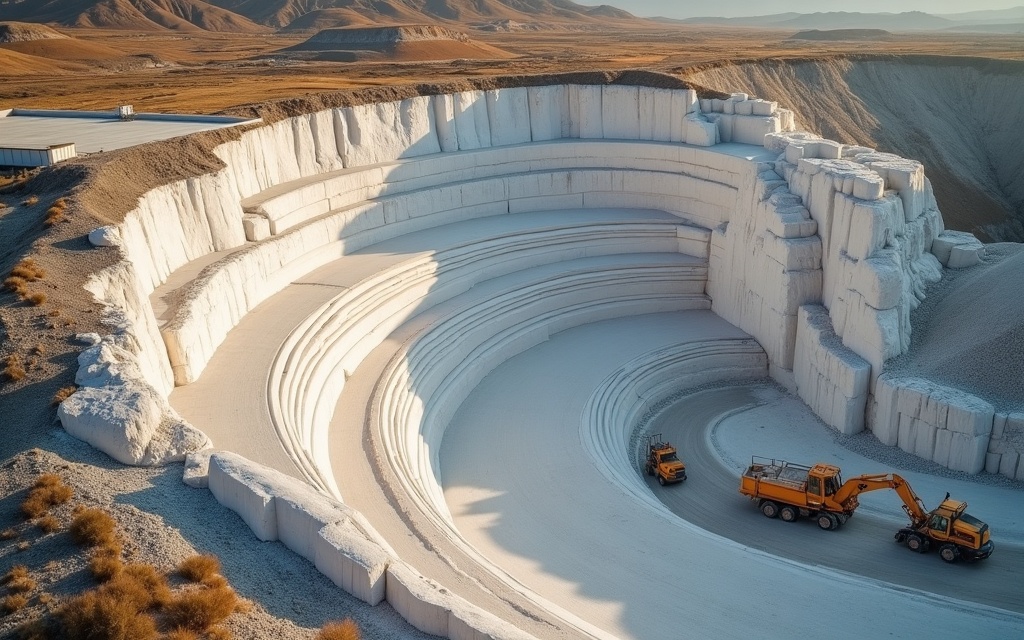
The extraction begins with channel cutting — precision cuts made into the rock face using diamond wire saws, diamond-tipped chainsaws, or sometimes controlled explosives. These cuts create a grid pattern that allows large blocks to be freed from the quarry wall. The quarry is worked in benches (horizontal levels), each typically 10–20 metres high, allowing safe and systematic extraction from top to bottom.
Block Separation
Once the cuts are complete, hydraulic wedges or carefully placed charges are used to separate the massive blocks — some weighing up to 30 tonnes — from the quarry face. Skilled operators must judge the natural fissures and grain of the stone to ensure blocks come away cleanly without cracking. This is where decades of experience make an enormous difference.
Block Inspection and Selection
Each block is immediately inspected for quality. Experienced quarry workers assess the colour consistency, veining pattern, and structural integrity. Blocks that meet quality standards are marked with their grade and destination, while lower-grade material may be set aside for use in aggregates or landscaping products.
Transportation: Moving Mountains
Getting multi-tonne stone blocks from the quarry floor to the processing facility is a logistical challenge. In mountain quarries, blocks are loaded onto heavy-duty excavators and transported via reinforced haul roads to the quarry pad. From there, they are loaded onto flatbed trucks — each truck typically carrying just 1–3 blocks depending on size — for transport to nearby cutting facilities.
Some quarries have on-site processing plants, while others transport raw blocks to the industrial zones around cities like Afyon, Muğla, or İzmir. The entire chain from quarry face to factory gate can take anywhere from a few hours to a couple of days, depending on location and distance.
Processing: From Raw Block to Polished Slab
Gang Saw and Wire Saw Cutting
At the processing facility, massive steel-framed gang saws slice the blocks into slabs. A gang saw uses dozens of parallel steel blades with industrial diamond grit to cut through an entire block simultaneously, producing multiple slabs in a single pass. This process can take 8–24 hours per block, depending on the hardness of the stone. Alternatively, diamond wire saws are used for thicker cuts or custom sizes.
Surface Finishing
After cutting, slabs are finished according to the customer's specification:
- Polished: A mirror-like finish achieved through progressively finer abrasives. Popular for interior applications.
- Honed: A smooth, matte finish that retains the stone's natural look while being less slippery.
- Brushed: A textured surface created by wire brushing, giving a rustic, aged appearance.
- Tumbled: Achieved by tumbling the stone with abrasives, producing softly rounded edges and an antique feel.
Quality Control
Every slab undergoes rigorous quality inspection before leaving the factory. This includes checking for cracks, colour consistency, thickness accuracy, and surface defects. At Atlasia Trading, we work directly with factory quality teams to ensure that only premium-grade material reaches our clients.
Sustainability: Modern Quarrying's Green Commitment
The natural stone industry has made significant strides toward sustainable practices. Leading Turkish quarries now implement:
- Water recycling systems that filter and reuse the water used in cutting and polishing.
- Land rehabilitation programmes that restore quarry sites after extraction is complete.
- Energy-efficient machinery that reduces fuel consumption and carbon emissions.
- Maximised block yield through advanced surveying and precision cutting technology.
Natural stone is inherently sustainable — it requires no chemical manufacturing, lasts for centuries, and is fully recyclable. Choosing Turkish natural stone for your project is an environmentally responsible decision.
Why Source Direct from Turkish Quarries?
Working with a supplier like Atlasia Trading that maintains direct relationships with Turkish quarries offers several key advantages:
- Competitive pricing: Eliminating intermediaries ensures you get the best possible FOB prices.
- Wider selection: Direct access to multiple quarries means a broader range of colours, patterns, and grades.
- Quality assurance: First-hand inspection of blocks before processing ensures consistent standards.
- Reliable supply: Long-standing quarry partnerships guarantee consistent availability and lead times.
- Custom specifications: Direct communication with quarry and factory teams allows bespoke requirements.
Conclusion: From Quarry to Your Project
The journey of natural stone from a Turkish mountainside to a finished installation is a remarkable blend of geological heritage, modern engineering, and artisanal skill. Understanding this process helps architects, designers, and builders appreciate not just the beauty of natural stone, but the extraordinary effort and expertise behind every slab.
At Atlasia Trading, we are proud to be part of this chain — connecting world-class Turkish quarries with discerning buyers across the globe. Whether you need white marble for a luxury hotel lobby, travertine for a garden terrace, or limestone for a modern facade, our team can source, process, and deliver exactly what your project requires.
Ready to explore our range of premium Turkish natural stone? Contact our team to discuss your project requirements, or browse our collections of marble, travertine, and limestone online.